
Transformers are not the only way one can boost voltage; another method to the madness is a Cockroft-Walton multiplier, or thes the Villard Cascade depending on your favorite dead scientist. “CWs”, as they are colloquially known, are a charge pump used to turn high voltage into very high voltage, a task in where transformers would not be suitable. Much like coupled inductors this circuit ‘trades’ current for voltage, but unlike a transformer, a CW outputs DC.
A CW consists of stages, each stage consisting of of 2 ultrafast diodes and 2 high voltage capacitors. These stages are then stacked up to make the multiplier.
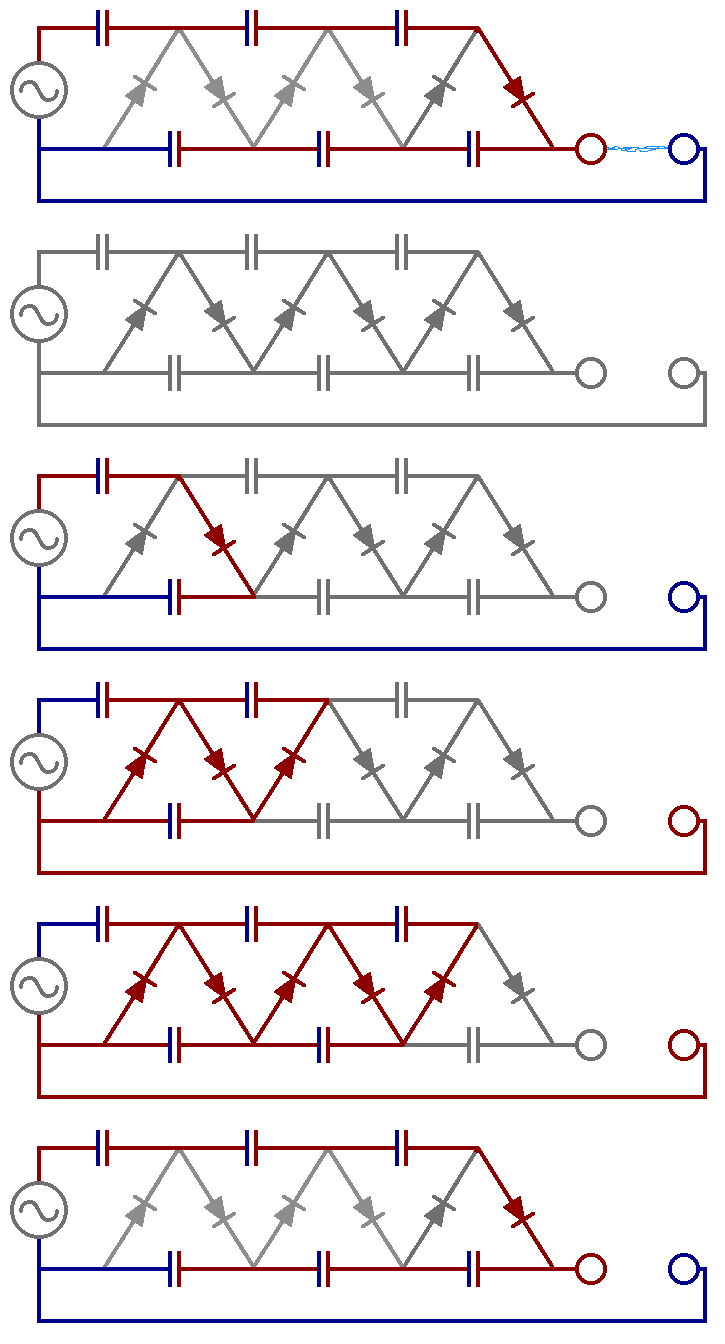
In reality it takes several more AC cycles for the capacitors to charge. How much the multiplier boosts the input voltage depends on the number of stages, and there is a simple formula for calculating such ideal voltage gain:
Eout = Ein * √2 * n
Eout is the output voltage
Ein is the RMS input voltage
n is the number of stages in the multiplier
Say you have a 6 stage multiplier and you feed it 7kV. By using the formula above you can calculate that the theoretical maximum output voltage will be 59.397kV.
The real world: challenges to expect
Like all real things in this world CWs aren’t perfect. The problem they have is as more current is drawn, the voltage gain starts to sag considerably. This loss can be counteracted by using either bigger capacitors or a higher frequency input, and the voltage drop can be roughly calculated using this formula:
Edrop = I / ( f * C ) * (2/3 * n³ + n² / 2 – n / 6)
Edrop is the voltage drop
I is the current drawn in amperes
f is the frequency in hertz
n is the number of stages
C is the size of the capacitors used in farads
This formula should definitely be taken with a grain of salt, because while it makes sense in theory, the loss in real life will be much higher. For example, a 4 stage CW on my workbench that theoretically should have dropped only 1.4kV per mA, actually dropped 8kV. That’s electronics for you.
As if voltage drop wasn’t enough, as current is drawn from the CW the output voltage starts to ripple. Once again there is a formula for calculating this;
Eripple = I / ( f * C ) * n * (n + 1) /2
Electrically CW’s blow, big time. Despite all their pitfalls they do work though, and until we find a better way of switch-mode boosting high voltage, they are all we’ve got. Both ripple and sag become larger problems as the number of stages is increased, so it’s always ideal to use as few stages as possible and as high a frequency as practical in a CW. This means you’ll need a high voltage high frequency source such as an AC flyback transformer to power such a multiplier.
Making one
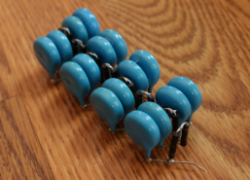
Making a CW is a rather easy task since it’s such a simple circuit, so simple in fact that you don’t even need phenolic board to do it. In the CW to the left I chose to use four stages, but as 30,000V capacitors are rather expensive, I improvised with pairs of 15kV caps in series (hence why there are 16 capacitors instead of 8). A CW should be under oil to prevent excess corona losses, so I made this one thin enough to be fit inside a PVC pipe. How you engineer your CW is your decision of course.
The extremely high voltages involved with CWs make wire resistance for the most part irrelevant. Resultantly, the capacitors are capable of discharging in multi-kiloamp pulses; far more than the little diode at the end of the stack can handle. This means that during use you’ll need either a resistive load such as an x-ray tube, or if you just want to make sparks a resistor in series with the output. Ohm’s law can help you determine what resistor you need, but expect it to be in the range of several million ohms. Remember that since there are very high voltages in place here there are also very high powers, so make sure your resistor is capable of handling the heat. A 1/4W resistor just ain’t gonna cut it!
The super high voltages that a CW can produce are quite fun to play with. At these extreme potentials huge E-fields can be made, as well as plenty of ionic wind. Simply sitting next to an operating CW you can feel the field charge up your arm hair (if you have any), and there is no shortage of radom electrostatic clicks and pops. Playing with a CW is quite an interesting experience.
The sparks they can make aren’t half bad either. ∎
Sam
I need an AC flyback transformer for my voltage multiplier. I could not find any supplier on the internet. Can you help me get it?